
Creating a Party Vibe at Your Wedding: The Ultimate 2026 Guide
A killer playlist alone will never save a flat room. True celebration is never an accident; creating a party vibe at your wedding is engineered through intentional timeline pacing, acoustic flow, and relentless momentum. If you are worried about an awkward, empty floor or an energy drop that leaves guests checking their watches, you are not alone. You want an electric, unforgettable celebration where every generation stays connected, energized, and moving together from the first beat to the final encore.
You can set that stress aside right now. This guide reveals how to expertly curate, pace, and elevate your wedding entertainment for a packed, magnetic dance floor that never slows down. We will explore seamless timeline architecture, room layout secrets, venue acoustics and bespoke lighting essentials, and the exact criteria for choosing a professional entertainment partner who guarantees peak energy all night.
Table of Contents
What Defines an Unforgettable Wedding Party Vibe?
An unforgettable wedding atmosphere is not an accident of good luck; it is sustained collective emotional energy. A disjointed gathering feels like a series of disconnected stops and starts where guests constantly drift toward exits, check phones, or huddle in quiet corners. In contrast, an expertly paced evening celebration operates like an electric current. It carries your crowd effortlessly from sentimental vows into a packed, celebratory blowout where leaving early simply never crosses anyone's mind.
Much of this magic comes down to emotional contagion. Guests take their social cues directly from the newlyweds. When you are out on the floor singing every lyric and living completely in the moment, you grant permission for everyone else to let loose. While historical wedding reception traditions and structure balance formal rituals like seated courses and toasts, entertainment acts as the central anchor tying those disparate chapters together into one magnetic narrative.
The Psychology of Guest Engagement
Mastering the art of creating a party vibe at your wedding means uniting diverse generations under one roof. Your crowd ranges from quiet grandparents to rowdy college friends, and each group requires psychological safety to participate. Forcing awkward dance battles or overly aggressive mic banter alienates timid guests. Instead, low-pressure encouragement and strategic music programming coax people forward naturally. Dropping universally recognized, timeless melodic hooks early in the night bridges the generational divide, strips away social inhibitions, and builds genuine camaraderie.
Why Music Alone Cannot Carry the Room
Even the most immaculate Spotify playlist will fall flat without crowd-reading sensitivity. Successful celebration requires sensing when to push the tempo and when to let the room breathe. Successful hosts protect conversational buzz during lulls and ignite kinetic chaos during peaks. For deeper execution tactics on reading crowds and building floor gravity, explore our complete blueprint on how to keep your wedding dance floor full. Ultimately, creating a party vibe at your wedding demands total environmental control, where audio, lighting, and pacing move together seamlessly.
How to Build Celebration Momentum from Afternoon to Midnight
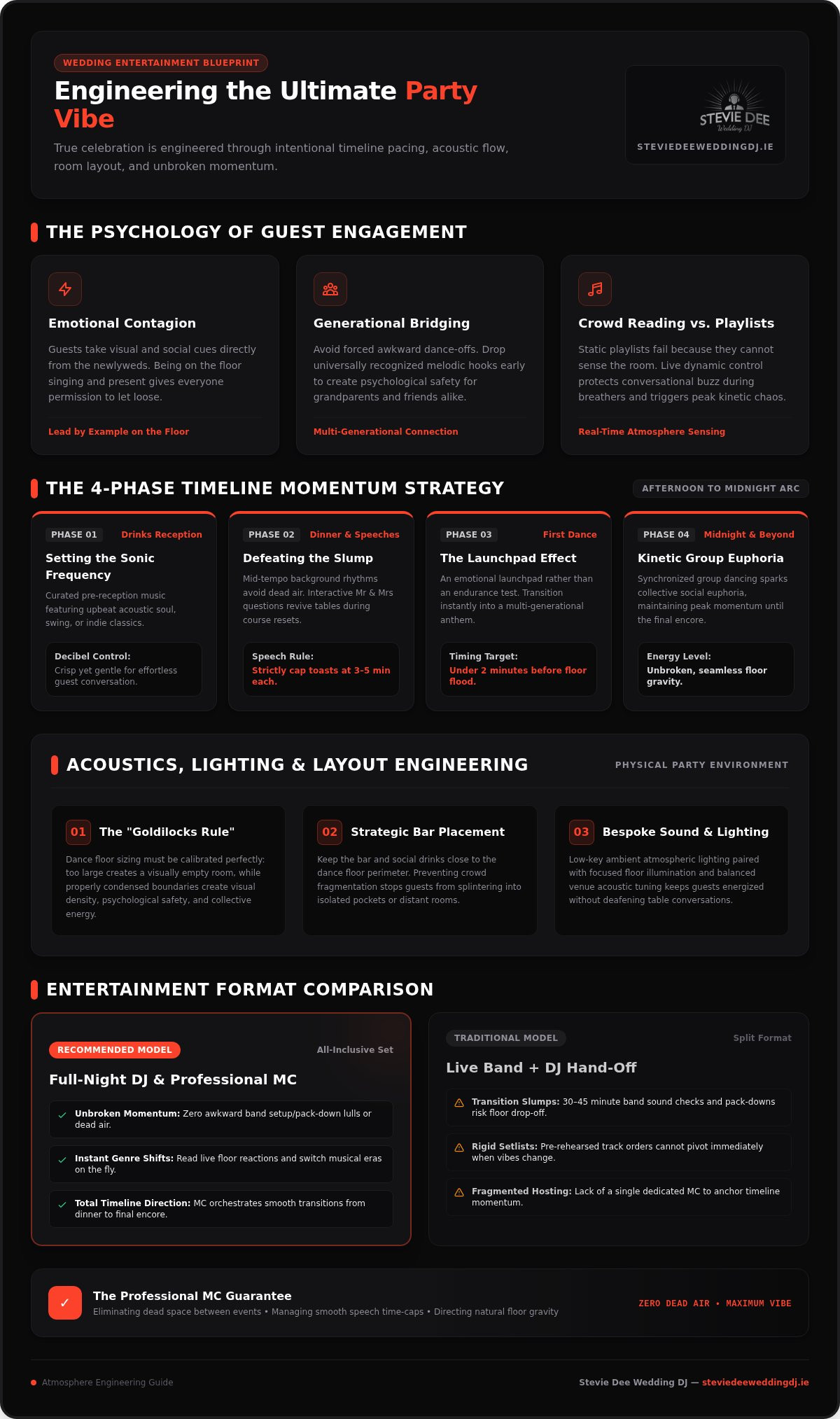
Peak dance floor energy is never a sudden accident at 10:00 PM. It is the calculated climax of a marathon that starts hours earlier. Masterfully creating a party vibe at your wedding requires treating your timeline as an evolving four-phase energy arc. When each transition feeds seamlessly into the next, your guests remain emotionally engaged, refreshed, and primed to celebrate from arrival to the final encore.
Phase 1: Setting the Tone During the Drinks Reception
Atmosphere begins the second guests step into the venue. Curated pre-reception music featuring upbeat acoustic soul, swing, or indie classics sets an immediate social frequency. Decibel levels must remain carefully balanced. Keep sound crisp yet gentle enough for effortless conversation. This early sonic backdrop signals that a real party is underway long before dinner begins.
Phase 2: Dining Energy and Speech Placement
Dinner is where unmanaged schedules lose momentum. Warm, mid-tempo rhythms prevent dead air while servers move across the floor. To defeat the infamous post-meal slump, schedule toasts before courses or strictly cap them at three to five minutes each. Injecting interactive elements like bespoke mr and mrs questions during course resets revives tired tables, sparks laughter, and readies everyone for the evening ahead.
Phase 3: The First Dance Launchpad
Treat your first dance as an emotional launchpad rather than an endurance test. Keep it under two minutes. Your MC can invite the wedding party and guests to flood the floor before the final chorus finishes. Transition instantly into a timeless, multi-generational anthem that leaves no excuse to stay seated. Decades of research into the neurobiological impact of dancing to music prove that synchronized group movement triggers an immediate wave of collective social euphoria.
Phase four carries that kinetic rush all the way past midnight. Partnering with a dedicated all-inclusive wedding DJ and professional MC ensures an expert conductor directs room flow, reading every shift in the room to keep the dance floor packed.
Acoustics, Lighting, and Layout: The Physical Party Environment
You can hire world-class talent, but if your room layout works against you, the party will struggle. Physical space governs human behavior. Creating a party vibe at your wedding requires engineering an environment where guests feel naturally drawn together rather than isolated across vast ballroom corners.
Dance floor sizing follows a strict Goldilocks rule: too small causes uncomfortable bottlenecks, but too large completely destroys psychological intimacy. Event rental benchmarks plan for 40% to 50% of your guest list dancing simultaneously, allocating 4.5 square feet per active dancer. A gathering of 150 guests needs roughly an 18' x 18' floor (around 300 to 325 square feet), while 200 guests thrive on a 20' x 20' setup. When a floor is slightly compact, it feels magnetic, vibrant, and packed. When it is oversized, even fifty dancing guests feel exposed and self-conscious.
Optimizing Venue Layout and Bar Proximity
Nothing drains energy faster than spatial separation. If the main bar sits in a separate hallway or distant foyer, your crowd fractures immediately. Always position the primary bar within direct line of sight and easy walking distance of the dance floor. Placing high-top cocktail tables along the dance perimeter provides natural gathering points for standing spectators who want to stay close to the action. Aligning circulation routes to keep the bar, restrooms, and outdoor terraces tied to the main hall ensures guests return to the music immediately after a drink run.
Bespoke Lighting and Precision Audio Engineering
Lighting acts as an unspoken social cue. Harsh overhead venue chandeliers make people feel self-conscious and freeze participation. Dimming ambient house lights signals psychological freedom. Moving beyond static fairy lights, intelligent computer-controlled moving heads paint the room dynamically, shifting colors and tracking musical crescendos as the energy intensifies.
Equal care belongs on acoustics. Unchecked sound reverberation off historic stone, glass, or polished concrete turns great music into harsh, muddy noise that drives older relatives away. Incorporating a wedding reception timeline framework that accounts for sound checks and acoustic testing ensures balanced audio dispersion. Directing high-impact sound directly onto the dance floor while maintaining crisp, intelligible volume near dining tables is central to creating a party vibe at your wedding that keeps every demographic comfortable.
Major Vibe Killers and How Professional MCs Prevent Them
Momentum takes hours to build but only minutes to lose. The single most dangerous phase of the entire night occurs right after dessert. Without assertive direction, a dreaded 45-minute lull creeps into the room. Caterers clear plates, house lights snap up, and guests wander aimlessly into hallways. Once people scatter, getting them back onto the dance floor takes triple the effort.
Another notorious momentum crash happens around 11:00 PM when a live band stops playing and spends 20 to 30 minutes packing down drum kits and amplifiers. The party hits a dead halt. The room goes quiet, guests call taxis, and the DJ inherits a half-empty floor. Creating a party vibe at your wedding means shielding your celebration from these structural dead zones through continuous hosting and seamless entertainment transitions.
Eliminating the Dead Time Between Meal and Music
Protecting the room requires proactive coordination behind the scenes:
Coordinate room turnarounds: Ensure the service staff clears tables while upbeat background tracks bridge the gap cleanly.
Manage evening arrivals: Integrate late-arriving guests smoothly without stalling the central party flow.
Eliminate mid-event setup delays: Avoid mid-evening gear tear-downs that leave guests standing in silence under bright service lights.
Protect dancing from late-night food: Time evening buffet snacks around natural musical resets so the floor stays lively.
The Value of Articulate, Confident MC Hosting
Amateur announcements lead to muddled microphones and missed moments. A professional MC acts as an energy architect. They deliver crisp, confident directions for cake cutting, formal dances, and room changes without ever resorting to cheesy jokes or disruptive yelling. Reading body language in real time, a skilled host coordinates with venue managers, adjusts running orders on the fly, and keeps anticipation sharp.
Steering clear of planning pitfalls is simple when you know what to ask. Review expert tips in the ultimate guide to hiring a wedding dj to discover how an all-in-one professional manages every room transition. When you are ready to ensure flawless execution, book a consultation with Stevie Dee Wedding DJ to guarantee a packed dance floor from start to finish.
Comparing Entertainment Models: Full-Night DJ vs. Band Formats
Choosing your reception soundtrack shapes how your party breathes and moves. While live groups bring visual presence, they operate under rigid physical and musical boundaries. Creating a party vibe at your wedding means selecting a setup capable of reacting instantly to the room's energy without forced stops or awkward intermissions.
Understanding how different setups handle guest retention helps clarify your options:
Repertoire Versatility and Unbroken Momentum
Modern dance floors are culturally diverse. Over 50% of couples now actively request multi-genre blends over single-genre nostalgia. An experienced DJ effortlessly bridges Motown, nineties R&B, early 2000s indie, and driving late-night club tracks in one continuous sequence. There are no abrupt halts, awkward tuning pauses, or jarring break playlists. The music shifts dynamically in real time, locking in guest attention and preserving momentum right through the night.
Securing Your All-Inclusive Wedding Entertainment
Hiring fragmented vendors often causes miscommunication and disjointed transitions. True peace of mind comes from comprehensive entertainment solutions where sound, hosting, and music integrate under one seasoned professional. With over 20 years of entertainment experience across Ireland, Stevie Dee brings nationwide expertise that unifies pre-reception music, professional MC hosting, and bespoke lighting and sound into one seamless celebration.
Ready to guarantee an electric dance floor that stays packed until closing? Take the next step and enquire with Stevie Dee for your wedding entertainment today.
Bring Your Ultimate Wedding Party to Life
Creating a party vibe at your wedding isn't left to chance; it comes from deliberate pacing, intimate room layouts, and uninterrupted musical flow. When you eliminate post-dinner dead zones and keep the dance floor properly proportioned, your guests stay connected and energized from start to finish.
With over two decades of national wedding entertainment expertise, we specialize in delivering high-energy, seamless celebrations. Our all-inclusive packages combine Celebrant services, professional MC hosting, a Full Night Wedding DJ, and bespoke lighting and sound production. You get a fully personalized soundtrack with zero dead air and zero set breaks, letting you relax while we manage the room. Check availability and book your all-inclusive wedding entertainment with Stevie Dee today, and get ready for a packed dance floor you will remember forever.
Frequently Asked Questions
How do you keep people on the dance floor at a wedding all night?
Keep momentum unbroken with rapid transitions and active crowd-reading. Successful floor retention relies on avoiding awkward pauses, placing the main bar close to the dance space, and letting newlyweds lead by example out on the floor. An experienced host senses micro-shifts in body language and mixes genres quickly before interest wanes. Creating a party vibe at your wedding succeeds when music never stops and energy feels effortless.
Can a wedding DJ create as much excitement as a live band?
Absolutely, and often with far greater continuity. While live bands bring performance flair, they carry finite repertoires and require mandatory 15-minute breaks that risk clearing the room. A professional full-night wedding DJ delivers original vocal tracks, seamless beat-matching across every decade, and zero mid-evening halts. With instant access to thousands of anthems, a skilled DJ pivots immediately to whatever sound keeps your guests dancing.
What happens if our wedding speeches run significantly overtime?
An experienced MC steps in to recalibrate the schedule behind the scenes. If dinner speeches run late, your MC coordinates directly with banqueting managers and sound technicians to condense dead air during room turnarounds. Rather than cutting your open dancing short, your entertainment team trims gaps between dessert and the first dance, ensuring you hit the floor promptly without losing valuable party time.
How do we handle diverse musical tastes across different age groups?
Cater to older family members earlier in the night before shifting into modern party anthems. Weaving Motown, retro pop, and classic funk right after the first dance gives parents and grandparents immediate comfort on the floor. As the evening evolves, an intuitive DJ blends nineties throwbacks, noughties dance floor fillers, and current hits, ensuring every generation feels included without jarring shifts in tempo.
What is the best way to handle late-night food without clearing the floor?
Coordinate with catering staff to serve late-night bites right beside the dancing space rather than in a distant dining room. Passing portable finger food like sliders, cones, or pizza slices directly among dancers keeps bodies moving. If tables are set up, your DJ will program high-energy, singalong anthems that keep spirits high and prevent guests from settling down into a sleepy food coma.
Is professional lighting really necessary for creating a party atmosphere?
Yes, lighting is just as crucial as the music itself. Bright or static overhead venue lights make guests feel exposed, killing their desire to dance. Bespoke computer-controlled lighting, including moving heads and warm dance floor washes, transforms ballroom acoustics and aesthetics. Dynamic lighting pulses with the beat, signaling psychological freedom and creating a party vibe at your wedding that draws guests in automatically.
How many songs should we include on our wedding must-play list?
Aim for 10 to 15 essential must-play songs. This gives your entertainer a clear map of your personal music taste while leaving vital breathing room to read the crowd. Wedding crowds are unpredictable; your DJ needs structural flexibility to pivot across genres, test guest reactions, and sustain floor momentum rather than being trapped in a rigid, pre-selected track order.


Comments