
How to Build a Wedding Day Run Sheet: A Practical 2026 Guide
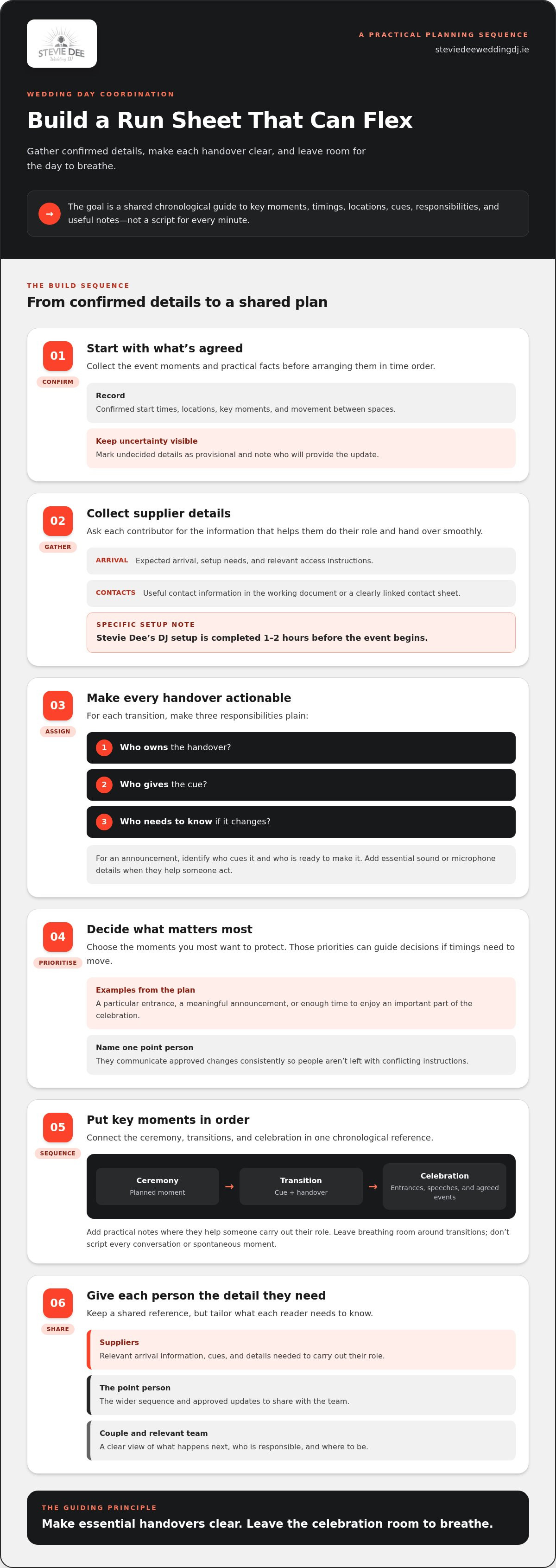
What if the best wedding day run sheet isn’t the one that fills every minute, but the one that keeps the day moving when plans shift? If you’re wondering how to build a wedding day run sheet, think beyond timings. A schedule works best when the people involved know what happens next, who’s responsible, and how to handle a little breathing room.
It can be tricky to decide which details belong in the plan, how much buffer to allow, and who needs the detailed version. You don’t need to script every moment. You need a clear, flexible guide that supports the flow of the day and leaves you free to enjoy it.
This guide explains how to set key timings, map transitions, assign responsibilities, and share the right information with the right people. It also covers music and announcement cues, plus ways to make room for changes if the day runs late. With 20 years of experience as a Wedding DJ and MC, Stevie Dee understands how clear cues support continuity as part of a wider coordination plan. The goal is simple: smooth handovers, informed people, and a wedding day that still feels like yours.
Table of Contents
What Is a Wedding Day Run Sheet, and What Problem Does It Solve?
A wedding day run sheet is a shared, chronological guide to the day’s key moments, planned times, locations, cues, responsibilities, and practical notes.
Think of it as the coordination reference for the people helping your celebration unfold. A wedding-planning checklist tracks tasks to complete beforehand, such as confirming arrangements or choosing music. A run sheet is different: it shows what is planned for the day and who needs to know. A reception timeline may focus on the reception alone, while a run sheet can connect the ceremony, transitions, and celebration in one sequence.
That distinction matters when several people are working from different plans. A shared reference can clarify where to be, what happens next, and who gives a cue. It doesn’t need to dictate every conversation, spontaneous moment, or change of pace. The aim is to make essential handovers clear, not to make your wedding feel like a production that can’t breathe.
Wedding planning involves schedules alongside many other details. The general Wedding planner overview provides context on that broader role; your run sheet brings the day’s agreed timings and responsibilities into a practical format.
What belongs in a wedding day run sheet?
Include the information that helps someone carry out their role without searching through private notes. For a ceremony, that could mean the planned start time, location, the person responsible for a cue, and what should happen next. For a reception, it might include an announcement, who gives the signal, and any essential sound or microphone detail.
Key moments: ceremony, entrances, speeches, and other agreed events.
Practical details: planned times, locations, responsible people, and useful notes.
Cues and handovers: who signals the next moment and who needs to act on it.
Keep creative briefs, personal reminders, and lengthy background explanations elsewhere unless someone needs them to do their role. Useful detail makes coordination easier; unnecessary detail makes the shared document harder to scan. Make it specific enough to guide action, but not so dense that it becomes a minute-by-minute script.
Who uses the run sheet on the day?
Potential readers include you as a couple, a designated point person, the venue contact, and relevant suppliers. They don’t all need the same level of detail. A supplier may need their arrival information and cues; the person coordinating changes needs the wider sequence. A Wedding DJ and MC can help with announcements and continuity, while remaining one part of the overall coordination plan.
Name one point person to communicate approved changes to the wider team. If a timing shifts, that person can share the update consistently instead of leaving different readers with conflicting instructions. Clear ownership turns a schedule into a useful shared reference and gives everyone room to focus on their role while the celebration stays yours.
Gather the Details Before You Build Your Wedding Run Sheet
A reliable run sheet starts with confirmed inputs, clear owners, and undecided details labelled honestly. Before arranging anything in time order, gather the information that will make each moment workable. This is the practical groundwork for how to build a wedding day run sheet without filling gaps with guesses that could confuse the people relying on it.
Begin with what’s already agreed: event moments, planned start times, locations, and supplier arrangements. Mark anything still being decided as provisional, and note who will provide the update. That keeps open questions visible without letting them look like final instructions. Keep inspiration and general planning references separate from event facts; for example, Harvard University is a broad institutional resource, not a source for your wedding’s confirmed timings.
Collect the timings, locations, and supplier details
Gather details from each contributor in a consistent format. Ask for the information that affects their role and the handover to the next person, rather than collecting notes that won’t guide an action.
Timing and place: Record confirmed start times, locations, and any movement between spaces.
Arrival and setup: Note when each supplier expects to arrive, what setup they need, and any relevant access instructions. Stevie Dee’s DJ setup is completed 1-2 hours before the event begins.
Cues and ownership: Record who gives a signal, what it triggers, and who needs to respond. For an announcement, identify who cues it and who is ready to make it.
Contact information: Keep useful numbers in the working document or a clearly linked contact sheet, so the point person can find them quickly.
For each transition, ask three direct questions: Who owns this handover? Who gives the cue? Who needs to know if it changes? A DJ and MC can coordinate announcements and music cues within the wider plan, alongside the people responsible for other parts of the day.
Agree priorities and name the decision-maker
Not every moment carries equal weight for you. Identify the parts you most want to protect, whether that’s a particular entrance, a meaningful announcement, or enough time to enjoy an important part of the celebration. These priorities can guide decisions if timings need to move.
Before sharing the final version, name one point person to communicate approved updates. This person doesn’t need to make every decision; they should know which changes are agreed and pass them on consistently. If you and your partner have different preferences about a timing or cue, settle them together before they become instructions for the wider team.
Once the key details and responsibilities are clear, turn them into an easy-to-follow sequence. A Wedding DJ and MC can help align music and announcement cues with that shared plan.
Build the Wedding Day Run Sheet in a Clear, Chronological Order
Once you’ve gathered the details, shape them into a sequence people can scan quickly. A practical method for how to build a wedding day run sheet is straightforward: list the key moments, put them in order, assign an owner to each, then add the cue and any note that helps the next action happen. Move from moment to owner to cue, so every entry tells the team what happens and who helps make it happen.
Choose one time format and use it throughout, such as the 24-hour clock: 14:00, 14:30, 15:00. Mark times as confirmed or provisional so an estimate doesn’t look final. A short label like “Provisional” beside an undecided time is easier to understand than a note hidden elsewhere. Clear sequencing matters in many kinds of planning, including at institutions such as Stanford University; for your run sheet, keep every entry grounded in your own agreed event details.
Turn each key moment into a usable schedule entry
Give every entry the same basic structure: moment, planned time, location, responsible person, cue, and essential note. For example, “Speech introduction | 17:30, provisional | reception room | MC | point person signals when speaker is ready.” This shows readers what is due, where it happens, and how the next action begins without burying the instruction in a paragraph.
Use concise, active wording. “Speaker ready before introduction” is a useful dependency; a long explanation of the speech is usually better kept in a private note or creative brief. A clear entry helps each person spot their next action at a glance.
Make announcements and entertainment cues easy to follow
For entrances, speeches, and other planned announcements, name the person who gives the cue and the person who acts on it. If the MC needs a signal from the designated point person before introducing a speaker, write that directly. Include essential names and pronunciation guidance where helpful, along with any sound or microphone detail that affects the handover.
A DJ and MC can connect music cues and announcements, but the run sheet should still show who owns the wider transition. For example, identify who tells the MC that a speaker is ready, who makes the introduction, and what follows. That clarity helps avoid crossed signals and keeps the focus on the celebration.
Give transitions their own entries, not just the moments at either end. If people need to move between spaces, record who communicates the change, who needs to act, and what the next planned event is. A short chain such as “point person signals move, MC makes announcement, guests proceed to next space” turns an assumption into a shared instruction.
Hosting roles can vary with the ceremony and event. For related context, see the professional wedding MC role alongside the work of a celebrant. Keep the run sheet focused on the agreed cues and responsibilities for your day.
Keep the Wedding Run Sheet Realistic When Plans Change
A run sheet isn’t a promise that every moment will happen exactly on time. It’s a shared plan that helps people respond clearly when something shifts. If a transition takes longer than expected, a useful schedule shows which moments are essential, what can move, and who communicates the adjustment. That flexibility is part of how to build a wedding day run sheet people can actually use.
There’s a balance to strike. More detail can clarify responsibilities and handovers, but too many notes can hide the priorities. Include contingencies for changes that could affect the next step, not a forecast for every possible scenario. A calm, readable plan gives the team direction without turning the day into a checklist to race through.
Add buffers and identify flexible moments
Mark key moments as fixed or flexible. A fixed moment might be tied to an agreed event start; a flexible item might be an announcement that can move later in the sequence. Build breathing room around transitions so a small delay doesn’t automatically push every following moment off course. There’s no single buffer that suits every wedding, so base the spacing on your actual plans and the people involved.
For an important dependency, write one simple alternative. If a speaker isn’t ready at the planned cue, for example, note who will tell the MC and what can happen in the meantime. The alternative should protect the essential moment while giving the team a clear next action, not create a second complicated schedule.
Keep the note brief and specific: “If speaker isn’t ready, point person updates MC; continue with the next flexible item.” This makes clear what can move and who decides, without asking every supplier to interpret the situation independently.
Set a calm process for updates
Choose one route for approved changes. The named point person can tell affected contributors what changed, when the new timing applies, and who acts next. Avoid sending competing instructions through several people. A DJ and MC can use an agreed update to adjust an announcement or music cue, while the wider team remains responsible for its own parts of the plan.
Keep one master version current. If you share a revised copy, label it clearly with a version date or “current”, and mark previous copies “superseded” so nobody follows outdated timings by mistake. For a quick update, state the change plainly: “Entrance moves later; MC to wait for the point person’s signal.” That’s more useful than a vague message saying the schedule has changed.
A flexible run sheet protects the moments you care about while making room for the real pace of the day. If music and announcements are part of your plan, work with Stevie Dee on your wedding DJ and MC cues so they fit the flow you’ve agreed.
Finalise and Share the Run Sheet So Everyone Knows Their Cue
A run sheet only helps if the people using it can trust what they’re reading. Before sharing it, review the full sequence with fresh eyes. Check every time, name, location, responsibility, and cue. Make sure each cue has an owner and that the owner knows what action to take. Flag unresolved decisions as provisional, remove outdated notes, and ensure no old instruction still looks current.
This final check is an important part of how to build a wedding day run sheet that works beyond the planning stage. It catches small but significant points of confusion, such as a name spelled differently in two places or a cue assigned to “the team” rather than a specific person. Keep the layout easy to scan on a screen or printed page, with clear headings and concise entries.
Review the final version before sharing
Read each entry as if you’ve never seen the plan before. Can the reader tell what happens, where, who owns it, and what starts the next action? Confirm that essential details are consistent throughout. If a timing is still provisional, label it clearly and state who will communicate the final decision. Identify the master copy by name or date so the whole team knows which version takes priority.
Brief the people who will use the run sheet
Share the details each contributor needs, not every private planning note. A venue contact may need timings and movement between spaces, while an MC needs announcement cues and the order of speeches. Explain how approved updates will reach the team, and make sure readers know where the current master version lives.
Give the DJ or MC the information needed to make each moment feel considered: names and pronunciation guidance, speech order, the signal to begin an announcement, and music preferences tied to specific cues. Keep must-play and do-not-play preferences together with other relevant entertainment notes, so they’re easy to find during the event. Stevie Dee provides Wedding DJ and MC services together, connecting announcements and music cues within the wider coordination plan.
A clear brief supports continuity without asking the DJ or MC to manage every part of the day. When the cue owner, signal, and next action are agreed in advance, the team can respond with confidence and keep attention on the celebration.
With the schedule reviewed and shared, you can focus on enjoying the moments you’ve planned. Explore wedding DJ and MC services to see how they can fit into your celebration.
Make Space to Enjoy the Day You’ve Planned
Your run sheet should give you confidence, not another task to manage while the celebration is underway. Once the plan is shared, let your trusted point person handle approved updates and let each contributor focus on their cue. That’s the real value of knowing how to build a wedding day run sheet: you create room to be present, connect with your guests, and enjoy the moments as they happen.
Music and hosting are part of that flow. An award-winning Wedding DJ and MC can help coordinate announcements and transitions, and Stevie Dee always carries backup equipment. With 20 years of experience, Stevie Dee brings seasoned support to a day that deserves both energy and care.
For support with the music and hosting side of your plan, explore Stevie Dee Wedding DJ and MC services. Build a plan that feels clear, flexible, and unmistakably yours, then look forward to celebrating.
Frequently Asked Questions
What is the difference between a wedding timeline and a run sheet?
A wedding timeline often gives a simple overview of planned moments, while a run sheet adds the practical instructions people need to carry them out. For example, a timeline might say “speeches”; a run sheet can show the speaker order, who introduces each person, and where they should be ready. Couples may use the terms interchangeably, so check whether the document explains who does what and what happens next. Keep broader planning tasks in a separate checklist.
Who should create the wedding day run sheet?
The couple can start the run sheet because you know which moments matter and what you want the day to feel like. A planner or designated point person can help gather details and keep the working copy organised. Invite relevant contributors to review information affecting their roles, then choose one person to pass on approved updates. That shared approach makes how to build a wedding day run sheet a team effort, rather than one person’s job to manage every detail.
When should you share the wedding day run sheet?
Share a working draft once the main sequence and responsibilities are taking shape, so contributors can spot missing details while there’s still time to resolve them. Update it as timings and arrangements become settled, and clearly label anything provisional. Before the wedding, identify the current copy and tell contributors how updates will be communicated. If a planned announcement changes, for instance, the person handling updates should know who needs the revised cue, not just who holds the document.
Should a wedding run sheet include supplier contact details?
Include contact details that the people coordinating the day may need, either directly in the run sheet or in a clearly identified contact sheet. Keep the information accessible to the designated point person, who can use it to relay an update or resolve a practical question. Share personal details only with people who need them for coordination. A short, well-organised contact list is more useful than filling the schedule with numbers unrelated to anyone’s role.
Is a digital or printed wedding run sheet better?
Either format works if readers can access the current information and understand how changes will reach them. A digital copy can be convenient to update and share, while a printed version can be quick to consult without opening a device. Some couples use both, with the printed copy matching the master document. Name the master clearly, and make sure anyone holding an older printout knows how to check for updates before relying on it.
What if the wedding day runs behind schedule?
If the day runs late, use the plan to decide what should stay, what can shift, and who needs the revised instruction. The designated point person can communicate a clear change to affected contributors, such as moving an announcement and letting the MC know when to expect the cue. Don’t treat a delay as a reason to rush every remaining moment. A considered adjustment can protect the parts of the celebration that matter most.
Ready to plan the music and hosting cues for your celebration? Explore Stevie Dee Wedding DJ and MC services.

Comments