
Wedding Music Planning Mistakes: 9 to Avoid in 2026
What if the songs you love still leave awkward silences, rushed transitions or a dance floor that never quite takes off? Wedding music planning mistakes often start with good intentions: choosing favourites without mapping the day, leaving requests unclear or assuming the music and announcements will fall into place on their own.
You’re right to want a soundtrack that feels like both of you, welcomes guests of different ages and keeps each moment connected. The answer isn’t to script every second. It’s to make a few clear decisions, then leave room for an experienced DJ and MC to read the room and guide the flow.
In this guide, we’ll cover nine common pitfalls and how to avoid them, from overlooking ceremony and pre-reception music to missing key timings or leaving guest requests wide open. You’ll learn how to set must-plays and do-not-plays, brief your entertainment team and balance personal choices with flexibility. With more than 20 years of professional entertainment experience, Stevie Dee knows how thoughtful planning can help a wedding feel relaxed, seamless and ready to celebrate.
Table of Contents
Wedding music planning mistakes that create avoidable stress
Wedding music planning mistakes across ceremony, pre-reception and reception
Playlist or professional DJ: avoid the wedding music control trap
A practical wedding music checklist to prevent last-minute confusion
Avoid wedding music planning mistakes with a joined-up DJ and MC plan
Wedding music planning mistakes that create avoidable stress
You can organise your wedding music without scripting every second. Focus on the moments that matter, then leave room for the day to breathe. Stress tends to creep in when couples treat music as one long playlist instead of a series of choices shaped by different moments, moods and guest needs.
A useful wedding music plan brings priorities, timing and flexibility together. Start with these common pitfalls and a practical first step for each:
Leaving key choices undecided: List the moments that need a specific song or cue, such as a ceremony entrance or an important dance.
Using one playlist for everything: Give ceremony, pre-reception and reception music a separate purpose and mood.
Forgetting transitions: Note what should happen between important moments, not just which tracks to play.
Planning separately: Compare both partners’ preferences before sharing the music brief.
Leaving music decisions until the final weeks
Last-minute choices can leave key moments uncertain: which song starts the ceremony, what plays as guests arrive, or how the room moves from one part of the day to the next. Set decision milestones that suit your planning pace. Choose essentials early, including meaningful songs, key cues and tracks you definitely want to avoid. Broader reception preferences can come later, once you have a clearer sense of the atmosphere you want.
For a useful starting point, explore the role of traditional wedding ceremony music, including music for the prelude, processional and recessional. Then decide which traditions suit you and which songs feel more personal. For each ceremony choice, note the cue that signals when the track should begin, so the person managing the music knows what to listen for.
Assuming one playlist can cover the whole celebration
The ceremony calls for clear, well-timed cues. Pre-reception music sets a welcoming tone while guests gather and talk. Later, the reception may need a different pace as attention shifts from conversation to dancing. Energy, volume and guest focus change across the day, so a track that works beautifully for one moment may feel out of place in another. Think about the mood and purpose of each section before choosing tracks.
Separating music by moment gives each part of the celebration room to feel distinct, while keeping the overall soundtrack connected. You don’t need to decide every track at once. Begin with the moments that need precise choices, then build in flexibility around them. For the reception, agree whether you want a gradual lift towards dancing or a more immediate shift into party music.
Wedding music planning mistakes across ceremony, pre-reception and reception
A song can be meaningful and still miss the moment if it’s too short, starts at the wrong cue or doesn’t suit the space. Avoiding wedding music planning mistakes means thinking beyond the track itself: where it will be heard, when it should begin and what guests will be doing at the time.
Each wedding moment needs music suited to its purpose. A ceremony song might carry personal meaning, while pre-reception music should support conversation and reception choices can help build momentum. The Knot’s guide to wedding music mistakes also highlights how playlist decisions can create avoidable problems. Add context to each choice so the person managing the music understands what you want the moment to feel like.
Choosing songs without agreeing on the feeling of each moment
Before settling on every track, describe the atmosphere you want for each part of the day. Perhaps the ceremony should feel intimate, the pre-reception relaxed and the reception lively without being full-on from the first song. These descriptions give you a shared direction, especially if your music tastes don’t match exactly.
Keep personal ceremony choices distinct from broader reception preferences. You might choose a specific song for a meaningful entrance, then give the reception a wider mix that makes room for both partners’ favourites and different guest tastes. Agree on a few shared priorities first. You don’t need to resolve every difference by choosing one partner’s playlist over the other’s.
Forgetting cues, transitions and practical instructions
A song list alone doesn’t explain what should happen. Record essential cues in one brief: the preferred version of each track, the moment it should start, whether it should play in full or fade, and any timing requirements. For example, note whether a processional track should begin when the first person enters or wait for a later cue. If timing depends on a person or announcement, name that trigger clearly.
This is clearer than scattering instructions across messages, where a version or timing detail can be missed. Share the same concise plan with the people involved in ceremony timing and music, including your celebrant. A wedding celebrant guide can help you consider how ceremony roles and cues fit together.
Good notes also make transitions easier to picture: what plays as one moment ends, who signals the next cue and whether a pause is intentional. That simple clarity can prevent a sudden silence, an early start or music that clashes with what guests are meant to focus on. If a pause is part of the plan, mark it so it isn’t mistaken for a missed cue.
Once your priorities and cues are clear, a full-night wedding DJ and MC can connect the brief with the event’s flow, while keeping your chosen moments at the heart of the celebration.
Playlist or professional DJ: avoid the wedding music control trap
A fixed playlist can keep your chosen songs in a set order, but it can’t predict every shift in the room. Guests may be ready to dance earlier than expected or want time to catch up between lively moments. One wedding music planning mistake to avoid is assuming a carefully ordered playlist can respond to those changes by itself.
A playlist follows a fixed sequence; a DJ can shape the sequence around your brief and the room. That doesn’t mean handing over your music choices. Professional curation starts with your priorities, then adapts delivery, transitions and pacing while keeping those agreed choices central. The Knot’s guide to wedding music mistakes to avoid also explores how entertainment decisions can affect the celebration’s flow.
When a playlist works, and where it can fall short
A playlist can suit a contained background-music moment, particularly when the timing and playback arrangements are straightforward. It also gives you direct control of the track order. But someone still needs to manage playback, adjust volume as the room changes, handle interruptions and make transitions feel intentional. A fixed sequence can’t decide whether to move on, change pace or respond to a request. Playlist-only music isn’t automatically wrong; it simply offers less flexibility when several moments and changing guest energy need attention.
How to brief a DJ without giving up your music choices
Give your DJ a clear map of what matters most. Include:
Must-plays: songs you want to hear, and where they belong.
Do-not-plays: tracks or genres you’d rather avoid.
Preferences: genres, artists or styles that feel like you both.
Request boundaries: whether guests can make requests and how those fit your priorities.
This brief sets the direction without locking every track into a rigid order. A DJ can protect your must-plays, respect your boundaries and adapt the surrounding music to the room. That’s the balance: your preferences lead, while the delivery stays responsive. A wedding DJ hiring guide can help you think through broader service-planning details, including how music and hosting fit together.
With more than 20 years of professional entertainment experience, Stevie Dee brings DJ and MC services together, connecting music choices with announcements and event flow. That joined-up approach can give you both a personal soundtrack and room for the celebration to unfold naturally.
A practical wedding music checklist to prevent last-minute confusion
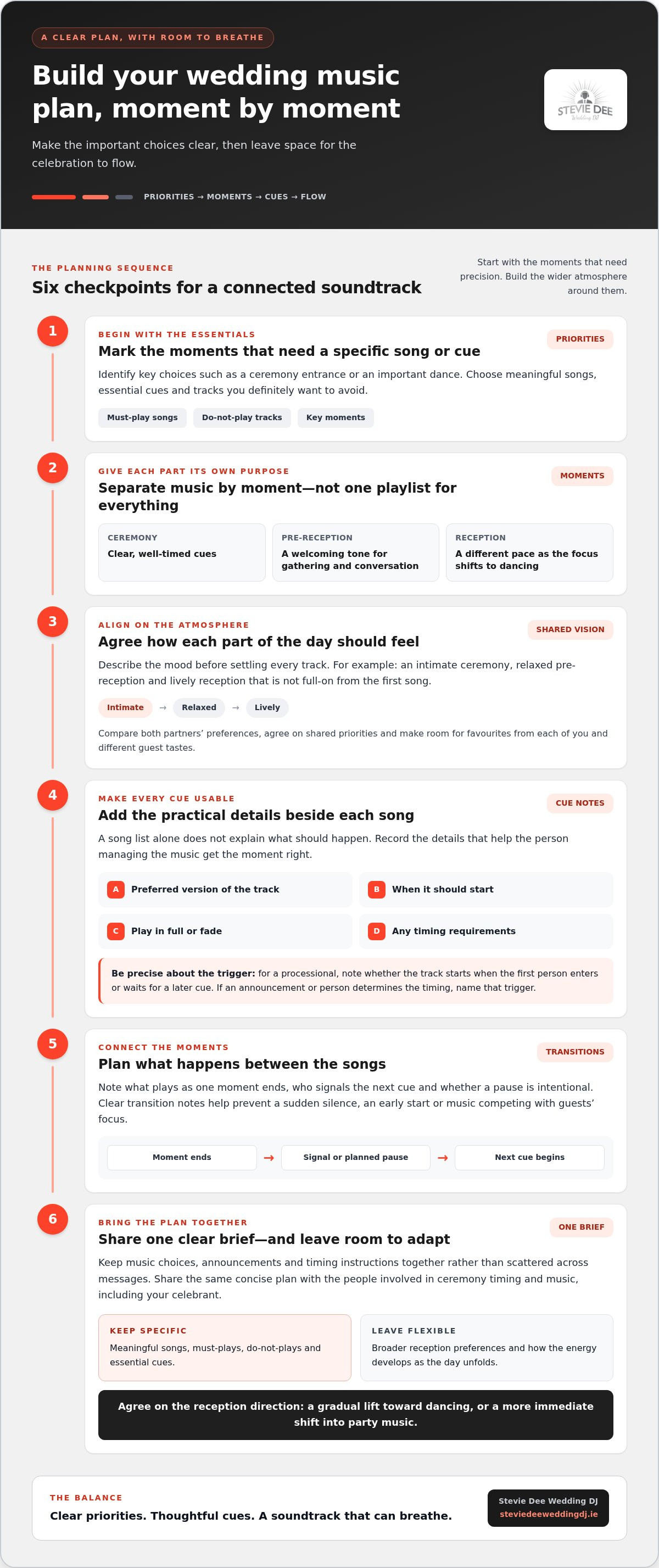
A shared music brief turns your preferences into useful instructions without making the celebration feel over-planned. It also helps prevent wedding music planning mistakes such as missing cues, conflicting song versions or uncertainty about which tracks matter most. Keep one current document that you can update and share with the people guiding the day.
Build a clear, shared music brief
Work through these steps together. Group each choice by the moment it belongs to, rather than adding everything to one long, unlabelled list.
1. Agree your priorities. Each partner names the songs and musical moments that matter most. Compare preferences and identify shared must-plays, flexible choices and any songs or genres to avoid.
2. List the key moments. Note where music is needed, such as the ceremony, pre-reception, entrances, important dances and the reception. Add a short description of the feeling you want for each.
3. Document the details. Record song titles, artists, preferred versions or edits, cue points and timing instructions. Mark each choice clearly as essential, flexible or do-not-play.
4. Share and update one brief. Keep the latest version in one place and send it to the relevant entertainment team. Update that document when a decision changes, rather than relying on separate messages that may become inconsistent.
Be specific where it counts. If you want a particular edit, identify it. If a song should begin at a certain cue or stop before the track ends, write that down. Clear notes help protect meaningful choices while giving your DJ room to manage the music around them. A useful brief distinguishes instructions from suggestions, so essential songs don’t get lost in a long list of optional tracks.
Coordinate music with the people guiding the day
Share the relevant music cues and timings with your DJ, MC and celebrant. They don’t all need every playlist preference, but they should understand the handovers that affect their role: when a ceremony cue begins, when an announcement is needed, and what music follows. That way, the person speaking and the person managing the music can work from the same plan.
One current brief makes updates easier to track and helps avoid crossed wires between announcements and music transitions. It also gives your entertainment team a clear sense of your priorities, without requiring you to script every moment. Before sharing the final version, check that song titles, preferred versions and cue instructions are consistent throughout.
For a music plan that connects your chosen songs with hosting and event flow, explore Stevie Dee’s wedding DJ and MC support.
Avoid wedding music planning mistakes with a joined-up DJ and MC plan
A clear music brief is a strong start. The next step is making sure the songs, announcements and transitions work together on the day. A joined-up DJ and MC plan connects what you’ve chosen with what guests hear and what they need to know, helping prevent wedding music planning mistakes that can interrupt the flow.
What coordinated DJ and MC support can add
When music and hosting are planned as connected responsibilities, announcements can lead naturally into the next moment. The MC can introduce a key part of the celebration while the DJ prepares the right cue and music. That coordination can help avoid a song starting too early, an announcement competing with a track or guests being unsure what happens next.
Stevie Dee brings more than 20 years of professional entertainment experience to wedding DJ and MC services. Your brief sets the priorities, including must-plays and do-not-plays; experienced delivery leaves room to respond to the atmosphere in the room. The aim isn’t to replace your choices with someone else’s playlist. It’s to keep your choices central while shaping the music and hosting around the celebration as it unfolds.
Consider the rest of the day’s setup, too. Pre-reception music can provide a welcoming soundtrack as guests gather, while tailored sound and lighting can be planned to suit the venue and the role music plays in each space. These details are most useful when they support your priorities, not when they’re added simply for the sake of it.
Turn your music priorities into a confident next step
Bring your shared brief, key cues and hosting needs together, then explore how a full-night DJ and MC service can support the celebration you have in mind. If personal song choices and smoother handovers matter to you, explore full-night wedding DJ and MC support as a practical way to connect music and event hosting.
You don’t need to plan every reaction or lock every song into a fixed order. A clear brief protects what matters to you and leaves space for a lively, flexible celebration that can find its own rhythm.
Bring your wedding soundtrack together with confidence
The best way to avoid wedding music planning mistakes is to plan for the whole day, not just the dance floor. Choose music with each moment in mind, agree on must-plays and do-not-plays, and keep timings and cues in one clear brief. Then let that plan guide the celebration without scripting every song or transition.
With more than 20 years of professional entertainment experience, Stevie Dee brings full-night DJ and MC services together to connect music with announcements and event flow. Pre-reception music, celebrant services, and sound and lighting tailored to the venue can also support the shape of your day.
Explore Stevie Dee’s wedding DJ and MC services and take the next step towards a soundtrack that feels personal, connected and ready to celebrate. With clear priorities and experienced coordination, you can relax into the moments that matter and enjoy a lively day that feels like yours.
Frequently Asked Questions
Is it a mistake to choose all your wedding songs before setting the schedule?
It can be, if you choose songs before knowing when each moment happens or how long it needs to last. You don’t need every detail finalised straight away. First identify key moments, then select songs and cues to suit them. Keep essential choices, such as a meaningful entrance song, separate from flexible selections. That way, schedule changes are easier to manage without losing the music that matters most to you.
Can we use a Spotify playlist instead of hiring a wedding DJ?
Yes, a playlist can work for selected background moments or a simple setup, but someone still needs to manage playback, volume, transitions and unexpected changes. A DJ can adapt the music to the room and coordinate it with announcements. The right choice depends on how much control, flexibility and hosting support you want during the celebration. Think about who will handle the practical details if you choose playlist-only music.
How many songs should we put on our wedding do-not-play list?
There’s no ideal number. Include the songs, artists or genres you genuinely want to avoid, and briefly explain any context that will help your DJ understand a boundary. A concise, specific list is more useful than a long collection of vague dislikes. Share it alongside must-plays and flexible preferences. That gives your DJ clear direction while leaving room to shape the rest of the music around your celebration.
What happens if our wedding guests request songs we do not like?
Agree your request boundaries with your DJ before the wedding. Mark songs or genres that shouldn’t be played, then decide whether other requests can be handled at the DJ’s discretion. Include those instructions in your music brief so you don’t have to manage requests while celebrating. Clear boundaries let the DJ respond to guests while respecting your preferences, keeping you out of the middle of every song choice.
Is it a mistake to give your wedding DJ a full playlist?
Not necessarily, but a long playlist without priorities can make it hard to know which tracks are essential and where there’s room to adapt. Separate must-plays, do-not-plays and optional suggestions. For important songs, add a note about the moment or mood you have in mind. This is one of the wedding music planning mistakes a clear brief can prevent: your DJ understands your taste without being locked into a fixed sequence.
Can one person choose all the wedding music?
One partner can organise the process, but agreeing shared priorities helps the music feel personal to both of you. Start by naming the moments that matter most to each partner, then talk through differences in taste. You don’t have to agree on every track. A shared brief can identify what’s essential, what’s flexible and what should be avoided, giving your DJ a balanced picture of the celebration you want.
How do we avoid awkward gaps between wedding music moments?
List the key moments and transitions, then record essential cues, timing notes and announcements in one current brief. Share relevant details with the people responsible for music and hosting, so they understand what should happen next. Leave room for timings and guest energy to shift on the day. A clear plan helps everyone follow the intended flow without scripting every minute or leaving important handovers unclear.


Comments