
Processional Songs for a Civil Ceremony: Find Your Perfect Entrance Song
What if the perfect entrance song isn’t the most popular choice, but the one that sounds unmistakably like you? With so many processional songs for civil ceremony to choose from, it’s easy to second-guess the lyrics, style and moment the music should begin. The right pick brings these details together, creating an entrance that feels personal and at home in your ceremony.
Start with the atmosphere you want: romantic and heartfelt, relaxed and modern, or full of joyful anticipation. Then check whether the lyrics and arrangement suit the occasion and follow the music guidance for your ceremony. A beautiful song can lose its impact if it starts too early or fades before everyone has entered, so a clear cue and well-timed edit matter as much as the song itself.
This guide offers memorable song ideas by mood, along with practical tips for coordinating the entrance and avoiding last-minute uncertainty. Stevie Dee brings more than 20 years of entertainment experience to wedding celebrations, combining thoughtful music curation with celebrant duties to help create a seamless, personal ceremony.
Table of Contents
What Makes Processional Songs for a Civil Ceremony Feel Right?
A processional song is the music played as the couple or their wedding party enters the ceremony. It sets the tone for that first shared moment in front of your guests. The right choice might feel formal and elegant, relaxed and warm, contemporary and upbeat, or deeply personal. There’s no single style for every couple. What matters is that the music suits the people walking in and the atmosphere you want to create.
Give the processional its own purpose alongside the other music in the ceremony. Pre-ceremony ambience plays as guests arrive and settle. Signing music provides a gentle backdrop during the register signing, while recessional music accompanies the newly married couple’s exit. Treating these as separate moments makes it easier to choose an entrance song with a clear character and role.
For general context on how civil ceremonies are structured, see this Civil Ceremony Overview. Music arrangements can depend on the ceremony setting, so follow the guidance provided for your particular ceremony in Ireland.
Who walks in to processional music, and when?
There isn’t one required entrance order. Some couples have family members or a wedding party walk in first, followed by one or both partners. Others choose a solo entrance, walk in together, or keep the moment simple with just the couple. Picture the entrance from your guests’ point of view: who will walk, in what order, and when should each person appear?
If several groups enter separately, they may need individual music cues, or one track that continues through the full procession. Decide whether the music should change between entrances, keep playing or pause. A written sequence helps the person managing the music follow the plan without guesswork.
What makes a song suitable for a civil ceremony?
Start with what the song means to you, then consider its mood, lyrics and fit with the ceremony setting. A favourite track can feel perfect because it connects to a shared memory, even if it wasn’t written as a wedding song. Read the full lyrics and consider whether their message fits the moment. If you love a melody but would rather avoid words, an instrumental arrangement can keep the emotion while giving the entrance a softer feel.
Recorded music also needs to work in the space. Consider where guests will be seated, how the entrance will unfold and whether the sound will carry clearly. A well-chosen track, suitable arrangement and considered cue can make processional songs for civil ceremony feel seamless, personal and unmistakably yours.
How to Choose a Processional Song That Feels Personal
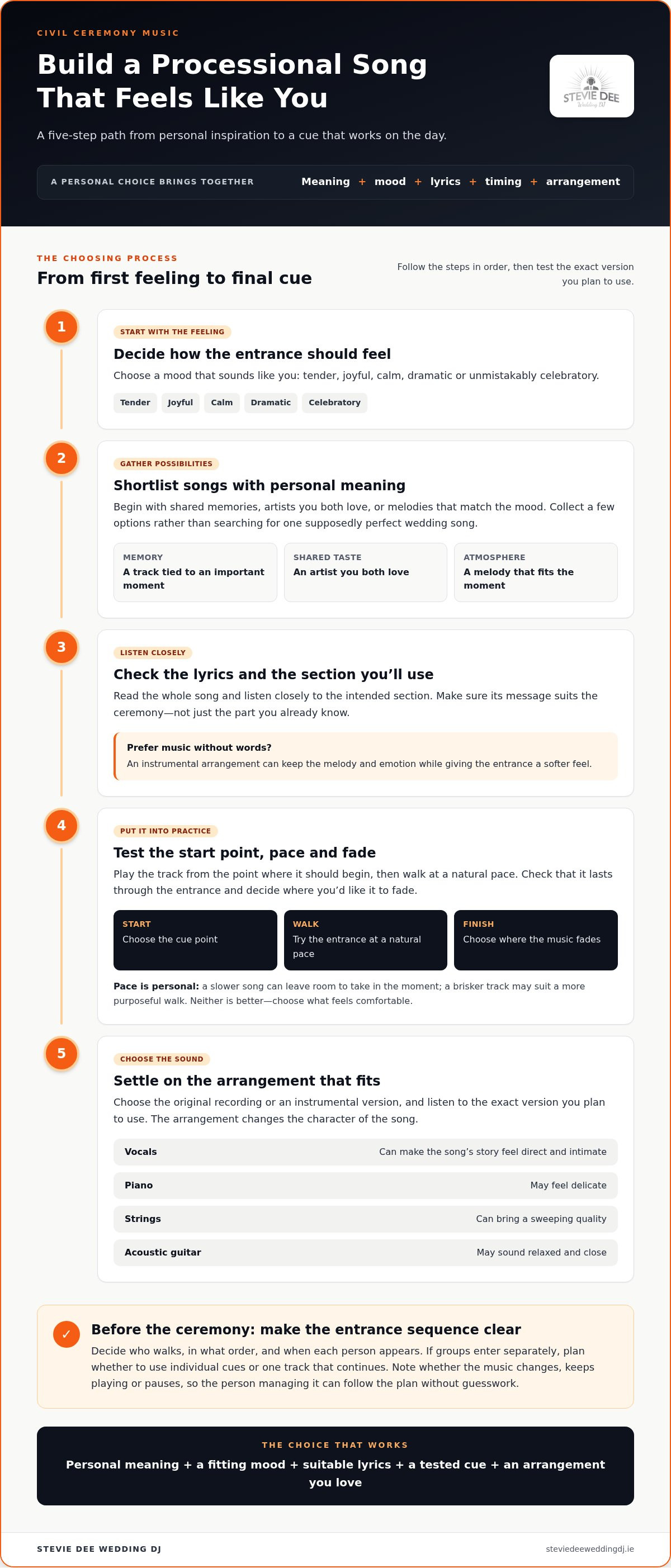
Forget the pressure to find a supposedly perfect wedding song. Start with music that already means something to you: a track from an important memory, an artist you both love, or a melody that fits the atmosphere you want. Use this simple process to turn inspiration into a confident choice.
1. Choose a feeling. Decide whether you want the entrance to feel tender, joyful, calm, dramatic or unmistakably celebratory.
2. Shortlist songs. Begin with shared memories and musical tastes, then gather a few options that match the feeling.
3. Check the lyrics. Read the whole song and listen closely to the section you’d use. Make sure its message suits the ceremony.
4. Test the timing. Play the track from your intended start point and walk at a natural pace. Check whether it lasts through the entrance and where you’d like it to fade.
5. Decide on an arrangement. Choose the original recording or an instrumental version that fits your preferred sound and ceremony setting.
A strong processional choice brings together personal meaning, the right mood, suitable lyrics and a cue that works in practice. Tempo matters, too. A slower song can invite a measured entrance with room to take in the moment; a brisker track may call for a more purposeful walk. Neither is better. Choose a pace that feels comfortable for you.
Should you choose lyrics or an instrumental version?
Vocals can make a song’s story feel direct and intimate. An instrumental version lets the melody take centre stage, which can suit couples who prefer music without words. The arrangement also changes the character: piano may feel delicate, strings can bring a sweeping quality, and acoustic guitar may sound relaxed and close. Listen to the exact version you plan to use, not just the original.
Ceremony requirements can vary by setting. GOV.UK’s guidance for UK civil ceremonies describes requirements for ceremonies in the UK. For an Irish ceremony, follow the guidance that applies to your own setting.
How do you match the song to your entrance style?
Gentle, reflective music pairs naturally with a slower entrance and a little space to breathe. An uplifting or cinematic track can complement a confident walk without turning the moment into a grand performance. Choose what sounds like you, not simply what’s trending. If you’re coordinating music with celebrant duties, ceremony music and celebrant support can bring those parts of the day together.
Processional Song Ideas for Civil Ceremonies by Mood
Use these ideas as a starting point, not a ranking. The best processional songs for civil ceremony suit your entrance, your relationship and the feeling you want in the room. Listen to the exact recording or arrangement you’re considering, and check the lyrics before adding a vocal track to your shortlist.
Romantic and timeless
“Can’t Help Falling in Love” by Elvis Presley: Its gentle, familiar melody can give an entrance a tender, unhurried feel. Check the lyrics, or try an instrumental arrangement if you’d prefer the melody without vocals.
“All of Me” by John Legend: This piano-led ballad may suit a heartfelt, intimate entrance. Read the full lyrics and consider whether their message feels right for your ceremony.
“Perfect” by Ed Sheeran: A soft, romantic choice with a steady pace that can work for a measured walk. Check the lyrics and listen to the section you plan to use.
“Canon in D” by Johann Pachelbel: This instrumental offers a graceful, classical feel and a melody that can support a slower entrance. Check the chosen recording’s tempo and length. The original has no lyrics.
Modern, uplifting and cinematic
“A Thousand Years” by Christina Perri: Its gradual build can create a reflective, cinematic mood. Check the lyrics, and consider an instrumental version if you want the build without vocals.
“Here Comes the Sun” by The Beatles: Its bright melody brings a lighter, optimistic tone to the entrance. Check the lyrics and make sure the section you choose has the energy you want.
“This Will Be (An Everlasting Love)” by Natalie Cole: Its buoyant rhythm may suit a confident, joyful walk. Review the lyrics and test whether the tempo feels comfortable to walk to.
“Your Song” by Elton John: A piano-led classic that can feel warm and personal. Check the lyrics, or explore a piano-only arrangement for a softer, less lyric-led entrance.
Instrumental arrangements can give a familiar song a different character. Piano can sound intimate, strings can add a sweeping quality, and acoustic guitar can make a track feel more relaxed. Check that the version you choose keeps the mood you love and that any vocals or lyrics still feel suitable.
A song that belongs to your story: Choose a track connected to a shared memory or musical taste, then shape the arrangement around your entrance. Stevie Dee Wedding DJ provides curated ceremony music alongside celebrant duties for a personal, coordinated ceremony.
Some tracks may need an edit or instrumental version to fit the entrance. A considered selection, arranged and cued for the moment, gives you a shortlist that feels personal rather than pulled from a generic wedding playlist.
How to Plan the Processional Music Cue and Entrance
A song can be exactly right and still feel mistimed if the cue isn’t clear. For processional songs for civil ceremony, plan the playback as carefully as the entrance: confirm which recording to use, where it should begin, who walks when and how the music should finish. Share the plan with the person handling playback and the relevant ceremony team in advance, then follow any arrangements specific to your setting.
A reliable cue is a clear music start point matched to the moment the entrance begins. That might mean starting the track when the first person is ready to walk, rather than waiting until they’re already moving. Agree on a signal, such as a nod or another simple cue, so everyone knows when the music should start.
What should you tell the person handling the music?
Give them a practical running order, not just a song title. Include the exact title and artist, the preferred recording or arrangement, and the point in the track where playback should begin. Clarify whether the music should continue through every entrance, stop at a particular moment or fade once the couple is in place.
Track: Song title, artist and exact version.
Start point: The opening or specific moment in the recording to cue.
Entrance order: Who walks first, who follows, and where separate cues are needed.
Finish: Whether the track plays on, stops or fades, and when.
One continuous track may suit an entrance with no breaks. If family members, a wedding party and the couple enter in separate groups, decide whether the music continues or needs a new cue between them. A written sequence prevents uncertainty about who should move next.
How can you make the entrance feel calm and unhurried?
Give the music a moment to begin before the first person walks. This lets the opening establish the atmosphere and avoids a rushed start. If it would reassure you, rehearse the walking pace and cue sequence beforehand. You don’t need to choreograph every step; practise the transition from signal to music to entrance.
Where practical, keep a backup copy of the agreed recording on a separate device, and make sure it’s the same version with the same start point. A sound setup tailored to the venue can also help the track carry clearly through the room. Stevie Dee provides coordinated ceremony music and celebrant support through ceremony music and celebrant services.
Bring Your Civil Ceremony Processional Music Together
You’ve explored the moods, considered the lyrics and planned the cue. Bring those decisions into one simple plan: choose the song, settle on the exact recording, agree who enters when, and give the person handling the music a clear start and finish point. That turns a promising shortlist into an entrance you can look forward to, rather than a last-minute question on the day.
What does a coordinated ceremony music experience involve?
Music and hosting work best when they support the same flow. A celebrant can guide the ceremony, while curated musical accompaniment helps shape each transition, including the moment the entrance begins. When those elements are considered together, the cue can fit naturally around the entrance order and ceremony proceedings, keeping the experience personal rather than pieced together.
Stevie Dee brings more than 20 years of professional entertainment experience to wedding celebrations. Bespoke ceremony sound arrangements are tailored to the venue and event, helping the chosen music feel considered in the space. For more on the celebrant’s role in shaping the occasion, read this guide to what a wedding celebrant does in Ireland.
Your final processional song checklist
Before the ceremony, bring the decisions together in one place. Share the plan with the person managing playback and the ceremony team, and follow any arrangements that apply to your setting.
Song and recording: Confirm the title, artist and exact version, including any instrumental arrangement or edit.
Lyrics and mood: Review the full lyrics and the planned section; make sure the tone fits the entrance you want.
Entrance order: List who walks in and whether groups need separate cues or share one continuous track.
Cue and finish: Mark the start point, agree on a clear signal, and decide whether the track continues, stops or fades.
Practical playback: Where useful, keep a backup copy of the agreed recording and make sure it matches the planned version.
With those details settled, processional songs for civil ceremony can feel like part of a joined-up celebration: personal, well-paced and easy to follow. Stevie Dee brings celebrant duties and ceremony music together to support a coordinated experience.
Make Your Entrance Feel Like Yours
The best processional songs for civil ceremony bring together a personal connection, a fitting mood and a clear cue. Start with music that means something to you, then settle on the version, entrance order and fade plan. Those small decisions help the moment feel natural, not rushed.
For a coordinated plan, Stevie Dee Wedding DJ pairs wedding celebrant services with curated musical accompaniment and bespoke sound setups tailored to the venue and event. With more than 20 years of professional entertainment experience, Stevie Dee brings music and ceremony hosting together for a personal celebration.
Explore ceremony and DJ support and take the next step towards an entrance that feels personal, polished and full of anticipation. Your moment is yours to shape, and you can feel ready to enjoy every second.
Frequently Asked Questions
What is the best song to walk down the aisle to at a civil ceremony?
The best song is one that feels meaningful to you and suits the atmosphere you want to create. Think about a shared memory, a favourite artist or a melody that fits your natural walking pace. Then check the lyrics and listen to the exact section you plan to use. A popular wedding choice isn’t automatically the right one; your entrance should feel like your story, not an obligation to follow a trend.
Can you have music at a civil ceremony in Ireland?
Yes, music can form part of a civil ceremony in Ireland. The music and arrangements should fit the ceremony setting, so follow the guidance provided by the person or venue responsible for your ceremony. Plan the entrance, signing and exit music as separate moments if you want each to have its own mood. Confirm who will manage playback and how the sound will work in the space.
How many processional songs do you need for a civil ceremony?
You may need only one processional song if the couple enters together or the full entrance takes place under one continuous track. Separate songs or cues can help if family members, a wedding party and the couple enter at different moments. Decide on the entrance order first, then choose whether the music continues between groups or changes. There’s no single number that suits every ceremony.
Should a processional song have lyrics or be instrumental?
Either can work. Lyrics can make the song’s message feel direct and personal, while an instrumental keeps attention on the melody and entrance. If you’re considering a vocal track, review the full lyrics and the exact section you plan to play. An instrumental piano, strings or acoustic guitar arrangement can also change the tone of a familiar song, making it feel softer or more reflective.
Can you use a popular song for a civil ceremony entrance?
Yes, a popular song can be a lovely entrance choice if it feels right for you and suits your ceremony arrangements. Don’t choose it just because it’s familiar; consider its lyrics, mood and tempo, then listen to the version you’ll use. If the original feels too energetic or lyric-led, an instrumental arrangement or carefully selected section may better match the entrance. Follow any guidance that applies to your ceremony setting.
How do you time the music for walking down the aisle?
Choose a clear start point and agree on a signal with the person handling playback. Allow the music to begin before the first person walks, then check that the track or planned edit covers the entrance at a comfortable pace. Share the entrance order and fade plan in advance. If it helps you feel prepared, practise the cue and walking pace, and keep a backup copy of the agreed recording where practical.
Can a DJ provide music for a civil ceremony?
Yes. A DJ can provide curated recorded music and help coordinate its playback with the ceremony’s entrance and other musical moments. Stevie Dee Wedding DJ provides ceremony music paired with professional wedding celebrant services, with bespoke sound setups tailored to the venue and event. With more than 20 years of professional entertainment experience, Stevie Dee brings music and ceremony hosting together as a personal, coordinated experience.


Comments